

Foot Valve vs Check Valve: Specific Differences
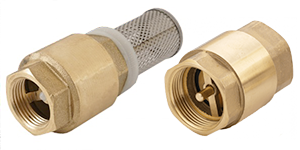
Figure 1: Figure 1: Foot valve (left) and check valve (right)
Foot valves and check valves are one-way valves that prevent backflow, but they serve different roles and are used in different parts of a system. The main distinction is that a foot valve has an integrated strainer and is purpose-built for suction lift applications, while a check valve is a general backflow prevention device used throughout a system.
Table of contents
View our online selection of check valves!
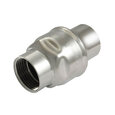

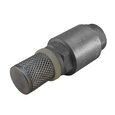
Foot valve
Main features
- Built-in strainer: A foot valve has a built-in strainer that filters out large debris before it enters the pump, reducing clogging and wear.
- One-end connection: It has a one-end connection, with the outlet threaded and the inlet open and screened.
- Flow direction: Foot valves allow flow from the water source into the suction line, typically vertical up. Some designs tolerate slight angles if submerged and sediment-free.
- Designed for suction lift: It is designed for suction lift applications and can open under pump suction even when no upstream pressure is present.
How and where is a foot valve used?
- A foot valve is installed at the bottom end of a suction line, fully submerged in the water source.
- It is essential in non-self-priming pumps, such as jet pumps and centrifugal pumps, to keep the suction line full of liquid and prevent loss of prime.
- It is widely used in well pumping, irrigation systems drawing from ponds or rivers, and sump pump applications where debris is present.
- It should be positioned at least 0.75 times the valve diameter above the bottom of the water source to minimize sediment intake.
Check valve
Main features
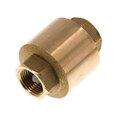
- No built-in filtration: A check valve does not have any built-in filtration, and a separate strainer must be installed upstream if debris is present.
- Two-end connection: It has two-end connections, with both inlet and outlet threaded or flanged.
- Flow direction: It can be installed in horizontal or vertical piping, depending on the valve design.
- Relies on upstream pressure: It relies on upstream pressure to open and, in suction applications, will not self-prime under pump suction. While it may open if the line is manually primed, it is not designed for this purpose.
How and where is a check valve used?
- A check valve can be installed anywhere in the piping system to prevent reverse flow after pumps, in branch lines, or at discharge points.
- It is suitable for pressurized piping networks, plumbing systems, wastewater lines, heating systems, and industrial process lines.
- It is often installed in series with pumps to prevent backflow when the pump stops, but it is not suitable for maintaining prime in suction applications.
- It is available in multiple designs, such as swing, spring, lift, ball, and Y-check valves, to match system pressure, orientation, and flow characteristics.
Foot valve and check valve P&ID symbols
Figure 2 shows a check valve symbol (left) and a foot valve symbol (right).
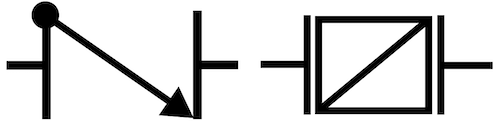
Figure 2: Check valve symbol (left) and foot valve symbol (right).
FAQs
Where are foot valves used?
Foot valves are used at the inlet of suction lines, typically in well pump systems, irrigation applications drawing from open water sources, and sump pump installations.
What's the difference between a foot valve and a check valve?
A foot valve is a check valve with an integrated strainer, fitted at a suction-line inlet to keep the pump primed. A check valve is a general one-way valve used throughout pressurized systems.
Which is better, a foot valve or a check valve?
Foot valves are better for maintaining pump prime and filtering debris in suction lines. Check valves are more versatile for general backflow prevention throughout a system.
Can a check valve replace a foot valve?
A check valve can’t replace a foot valve because it lacks a strainer and isn’t designed for suction lift applications.
Why does my pump lose prime even with a foot valve installed?
The pump loses prime if the foot valve leaks, debris prevents full sealing, or there’s air in the suction line.
What is the purpose of the strainer on a foot valve?
The strainer prevents debris from entering the suction line, protecting the foot valve and pump from clogging or damage.


