


When to Use a Butterfly Valve: Key Applications
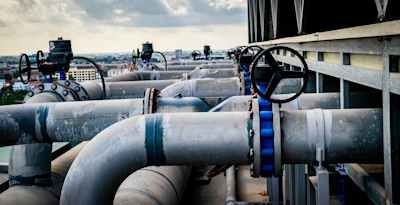
Figure 1: Butterfly valve for a cooling tower
Butterfly valves are a practical choice for a reliable shutoff or flow regulation in medium or large pipelines without adding extra weight or cost. Their compact design and quick quarter-turn actuation make them ideal for water, HVAC, and process systems where space is limited and efficiency matters.
Tameson engineers recommend butterfly valves for applications that require frequent operation, large diameters, or automation. This article explains when and where to use them, compares them with other valve types, and outlines key industries and limitations.
Table of contents
- Butterfly valves vs ball valves, gate valves, and globe valves
- Manual vs actuated butterfly valves
- Water and wastewater systems
- HVAC and building services
- Chemical and process industry
- Compressed air and gas systems
- Potable water systems
- Butterfly valve limitations
- FAQs
View our online selection of butterfly valves!
Butterfly valves vs ball valves, gate valves, and globe valves
Table 1: Butterfly valve vs other valve types
| Criteria | Butterfly valve | Ball valve | Gate valve | Globe valve |
| Operation | Quarter-turn or multi-turn with gearbox | Quarter-turn | Multi-turn | Multi-turn |
| Flow control | Good for on/off and throttling based on its design | Excellent for on/off, not designed for throttling | Good for on/off, but not designed for throttling | Good for on/off and throttling |
| Cost vs size | Economical at large sizes (5 inches and above) | Becomes very expensive in larger diameters | Moderate cost at medium to large sizes | Becomes very expensive in larger diameters |
| Pressure drop | Low to moderate | Very low | Very low | Moderate to high |
| Space requirement | Most compact (short face-to-face, low weight) | Compact in height, but longer face-to-face than butterfly valves | Requires more space in both dimensions | Requires more space in both dimensions |
| Viscosity | Suitable for slurry and viscous media | Not suitable for slurry, suitable for viscous media | Suitable for slurry and viscous media | Not suitable for slurry, not ideal for viscous media |
| Maintenance access | Easy | Moderate | Moderate | Difficult |
When to use manual or actuated butterfly valves
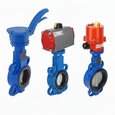
- Manual: Suitable for infrequent operation, basic isolation, and cost-sensitive applications, such as fire protection and small water lines.
- Pneumatic: Preferred in process industries for fast cycling, high-torque capability, and safe use in hazardous explosive areas, but requires a continuous air supply.
- Electric: Ideal for automated systems that require accurate positioning. However, they operate more slowly than pneumatic actuators.
.jpg)
Figure 2: Butterfly valve actuation mechanisms: manual (left), electric (middle), and pneumatic (right)
Water and wastewater systems
Butterfly valves are used in water and wastewater networks for isolation and flow control. They are installed on pump discharge lines for quick shutoff. They regulate flow in treatment plant pipelines, such as sedimentation, aeration, and sludge handling. They help separate zones during maintenance within distribution systems.
Butterfly valves are suitable for fluids with suspended solids, powders, or slurries, as their design helps reduce buildup at the pipe mouth. Their compact design makes them practical for underground chambers and plant galleries where space is limited. Butterfly valves are available in large sizes for main pipelines and intake structures.
HVAC and building services
Butterfly valves are used in HVAC systems for isolating and regulating chilled water, hot water, and condenser water circuits. They are typically installed at pump suction and discharge lines, across heat exchangers, and on AHU coil connections, allowing equipment maintenance without draining the whole loop. With electric actuators, they connect directly to building management systems for automated flow control and precise temperature regulation.
Chemical and process industry
Butterfly valves are used in pipelines carrying cooling water, process water, acids, solvents, and some slurry streams. They function as isolation valves for maintenance, throttling devices in mixing or reaction loops, and block valves on storage tank inlets and outlets. Their compact design makes them practical on large process headers and in congested pipe racks.
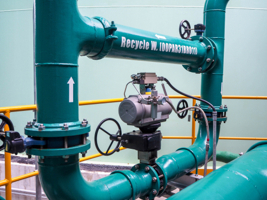
Figure 3: A pneumatically actuated butterfly valve installed in a power plant
Compressed air and gas systems
Butterfly valves are ideal for emergency shutdowns and fire suppression systems where quick isolation is critical. They are typically placed at compressor discharges, receiver tank outlets, and main pipelines for rapid shutoff, and at branch connections to isolate plant sections without shutting off the entire network.
In natural gas or biogas service, reliable tight shutoff is essential to prevent leakage, backflow, and safety hazards. For hazardous areas, only ATEX-certified valves with proper gas approvals should be used. Pneumatic actuators are preferred in these environments and in fast-acting shutdown applications, as they avoid the risk of electrical sparking.
Potable water systems
Butterfly valves are used in potable water networks for isolation and flow regulation in transmission and distribution pipelines. They are installed at pump discharges, treatment plant outlets, storage reservoirs, and distribution mains to allow maintenance without interrupting supply. On branch lines, they help control flow and isolate zones during repairs.
To meet hygiene standards, valves must comply with standards like DVGW. Their compact design suits underground chambers and confined plant spaces, while large-diameter types provide a cost-effective option for trunk mains and intake pipelines.
Butterfly valve limitations
- Not suitable for high-pressure throttling: Butterfly valve performance is limited to low-pressure applications; globe valves are better for precise control at higher pressures.
- Cavitation and choked flow: The disc remains in the flow path, which can cause turbulence, debris buildup, and flow restriction, especially in wastewater service.
- Non-piggable design: The permanent disc in the bore prevents cleaning with pipeline pigs or similar devices.
FAQs
What is the most common use of a butterfly valve?
Butterfly valves are commonly used for isolation and flow regulation in large-diameter water, wastewater, and HVAC pipelines.
What is the main advantage of a butterfly valve?
Butterfly valves are compact, lightweight, fast, and provide cost-effective shutoff and control, especially at larger pipe diameters.


