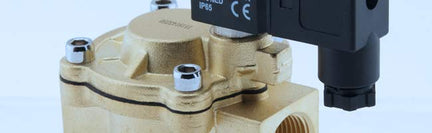



Collection:Solenoid Valves


Solenoid Valves

A solenoid valve is an on/off valve for liquids, gases or compressed air, actuated by an electric coil. Thanks to the simple construction and fast switching, it is the standard choice for automating shut-off in many industrial processes. Although most valves are used for open/close, proportional versions exist for gradual and fast flow regulation. Tameson supplies solenoid valves from JP Fluid Control, Burkert and other leading manufacturers, with engineering support for selection and same-day shipping.
How does a solenoid valve work?
When current flows through the coil, it generates a magnetic field that moves a ferromagnetic plunger inside the valve body. The plunger either opens or closes the valve seat, allowing or blocking flow. When the current is switched off, a spring returns the plunger to its rest position. This is why every solenoid valve has a defined circuit function: normally closed (NC) opens on power, normally open (NO) closes on power. In indirect operated valves, the solenoid operates a small pilot port to control a pressure chamber that controls the valve's opening. These valves require a pressure differential of typically 0.2-0.5 bar (3-7 psi) to work.
What are solenoid valves suited for?
Solenoid valves are particularly well-suited for:
- Fast, automated on/off switching of clean liquids, gases and compressed air
- Remote control of flow from a PLC, timer or simple electrical signal
- Applications with frequent switching cycles
- A wide range of media when matched with the right body and seal materials
- Compact installations where space is limited
What are solenoid valves not suitable for?
Specific solenoid valve designs exist for demanding conditions (coaxial valves for viscous, abrasive or contaminated media, and certain pilot-operated designs from manufacturers like Burkert for dirty media). For most other cases, however, standard solenoid valves are generally not the first choice for:
- Viscous, dirty or abrasive media: The small clearances around the plunger, diaphragm or pilot port quickly get clogged or worn by particles, sticky residues or high-viscosity fluids. Specialized coaxial valves and certain pilot-operated designs handle these conditions, but standard solenoid valves will not.
- Manual operation without power: Solenoid valves require an electrical signal to switch. For systems that must operate during power outages or in locations without electrical infrastructure, a manual valve or pneumatically actuated valve is more appropriate.
- Large diameters (typically above DN 65): At larger sizes the coil power needed to switch the valve becomes impractical. Electric ball valves or butterfly valves take over above this range.
- Long operation without proper heat dissipation: Most solenoid valves are rated for continuous duty, but the coil generates heat whenever it is energized and needs to release that heat to the surroundings. In enclosed or hot installations this can shorten coil life. For applications that stay open or closed for long periods, an electric ball valve only uses power during switching and may be a better fit.
- Bidirectional flow at high pressure: Most solenoid valves are designed for one flow direction; reverse flow can damage seats or cause uncontrolled opening. Specific bidirectional designs exist but are not the default.
Which type of solenoid valve do you need?
- 2-way solenoid valve: One inlet, one outlet. Open or closed. Choose this for simple on/off control of water, air, oil or fuel.
- 3-way solenoid valve: Three ports for switching, mixing or diverting flow. Choose this for single-acting pneumatic cylinders or switching between two media.
- Proportional solenoid valve: Continuously variable opening based on a 0-10 V or 4-20 mA control signal. Choose this when you need to regulate flow or pressure, not just switch it.
- Coaxial solenoid valve: For high pressures and viscous, abrasive or contaminated media. Choose this where standard solenoid valves fail.
- Pneumatic solenoid valve (5/2, 4/2, 3/2): For controlling pneumatic cylinders and actuators in machine building and automation. Choose this for compressed air control.
- Hydraulic solenoid valve: For high-pressure hydraulic systems. Choose this for mobile hydraulics, construction equipment or braking systems.
- Solenoid valve accessories: Coils, connectors, timers and revision kits.
How to choose the right solenoid valve
Five parameters drive almost every selection:
- Media and temperature: These determine the body material (brass for neutral media such as water, air and most oils; stainless steel for aggressive media; plastic for pure water or chemicals) and seal material (NBR, EPDM, FKM, PTFE).
- Circuit function: Normally closed (NC) opens when energized and returns to closed when de-energized; normally open (NO) closes when energized and returns to open when de-energized. The right choice depends on which state the valve should be in when power is absent.
- Operating pressure: Match the valve's rated pressure range to your system. Note that indirect-acting valves require a minimum differential pressure (typically 0.2-0.5 bar or 3-7 psi) to operate, while direct-acting and semi-direct valves work from zero differential pressure.
- Sizing and connection: Choose the port size and connection type (BSP, NPT, flange, solvent-weld) to match your piping, and verify the Kv value to ensure sufficient flow at your working pressure. Our Kv calculator helps with this.
- Voltage: Solenoid valves are available in a wide range of voltages including 12 V DC, 24 V DC, 24 V AC, 110/120 V AC and 230 V AC. DC voltages are common in mobile and battery-powered systems; AC voltages match local mains power.
Not sure? Use our solenoid valve selection guide to find the right type in a few steps.
Frequently asked questions about solenoid valves
What's the difference between direct-acting, semi-direct and indirect-acting solenoid valves?
A direct-acting solenoid valve opens by the coil lifting the plunger directly, with no differential pressure required, but it is limited to smaller orifices. A semi-direct (or assisted-lift) valve combines direct plunger action with a diaphragm, allowing larger orifices while still working from zero differential pressure. An indirect (servo-assisted) valve uses media pressure to open a diaphragm, allowing much larger flow rates but requiring a minimum differential pressure of typically 0.2 to 0.5 bar between inlet and outlet (3-7 psi).
Why is my AC solenoid valve buzzing or humming?
A slight hum is normal on AC coils because the magnetic field cycles with the mains frequency. Loud buzzing usually indicates a damaged shading ring in the armature, a foreign particle preventing the plunger from seating fully, or low voltage at the coil. Check the coil voltage and clean the valve before replacing parts.
Why is my solenoid valve coil getting hot?
Coils are designed to run warm in continuous operation, often 60 to 90 °C surface temperature (140-190 °F). This is normal and not a fault. Overheating beyond the rated insulation class can occur from incorrect voltage, ambient temperature above the rated maximum, or a stuck plunger drawing inrush current continuously.
Do I need a filter or strainer in front of a solenoid valve?
Yes, in most cases. Solenoid valves are sensitive to dirt and small particles, which can prevent the plunger or diaphragm from seating fully and cause leakage or sticking. A simple Y-strainer ahead of the valve significantly extends its service life on water, air and fuel lines.
In which orientation should I install a solenoid valve?
Most solenoid valves are designed to be installed with the coil pointing upwards and with flow in the direction of the arrow on the body. Other orientations are often allowed but may reduce service life or affect operation on contaminated media. Check the datasheet for the specific model.
What's the difference between a solenoid valve and a motorized ball valve?
A solenoid valve switches fast and is ideal for clean media in smaller sizes, but consumes power continuously while energized. A motorized ball valve switches more slowly, handles dirty media and larger diameters better, and only uses power during the opening or closing motion. For long hold-open or hold-closed states, a motorized ball valve is often more energy-efficient.