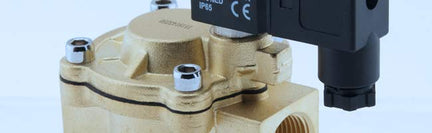



Collection:SMC 5/3-Way In-Line Pneumatic Solenoid Valves SY3000
SMC 5/3-Way In-Line Pneumatic Solenoid Valves SY3000 offer high-performance solutions for various pneumatic applications. These 5-port solenoid valves provide exceptional flow rates while mainta... Read more
SMC 5/3-Way In-Line Pneumatic Solenoid Valves SY3000

SMC 5/3-Way In-Line Pneumatic Solenoid Valves SY3000 offer high-performance solutions for various pneumatic applications. These 5-port solenoid valves provide exceptional flow rates while maintaining low power consumption, all within a compact design. Available in body ported or base mounted styles, they can be used individually or as part of a manifold system, offering versatility in installation.
Operating with air as the fluid medium, these valves accommodate a pressure range of 0.1 to 0.7 MPa for internal pilot configurations. External pilot versions extend the range from -100 kPa to 0.7 MPa, with a pilot pressure range of 0.25 to 0.7 MPa. The effective area for body ported models is 4.14 mm² (Cv 0.23), while base mounted versions offer 5.4 mm² (Cv 0.3), ensuring efficient flow control across different setups.
Flexibility in power requirements is a key feature, with coil rated voltages available in 3, 5, 6, 12, and 24 VDC, as well as 100, 110, 200, and 220 VAC options. The valves demonstrate rapid response times of 15 ms or less at 0.5 MPa, without indicator lights or surge voltage suppressors. Designed to operate in diverse environments, these valves maintain performance in ambient and fluid temperatures up to 50°C, making them suitable for a wide range of industrial applications.
When selecting SY3000 valves, consider the specific pressure requirements, mounting preferences, and electrical specifications of your system to ensure optimal performance and compatibility. The combination of high flow capacity, energy efficiency, and compact design makes these valves an excellent choice for pneumatic control systems seeking to balance performance with space and energy constraints.